

About
About The PS-F5
The Sony PS-F5 is a marvel of engineering, first sold by Sony in 1983. It’s a small, portable turntable which runs off regular AA batteries or an external power supply. It plays 7″ or 12″ records at 45 or 33.3 RPM and most impressively it will do so either laying down or standing up, due to its linear tracking, direct drive and record clamping system. It has dual headphone sockets so you can listen with a friend or plug it into an amplifier. A nifty swivelling foot arrangement stows in the base of the player. Upon rotating the rubber-covered chrome plated steel feet, they extend out of the front and rear, giving extra stability when standing upright.
PS-F9: Same But Different
There is also the PS-F9, which is harder to find than the F5 in America and Europe, but more common in Japan. This is pretty much the same device except for the following additional features:
- Quartz lock: accurate speed control using the highly regular vibrations of a quartz crystal to govern the platter’s speed of rotation
- Pearlescent painted exterior (doesn’t suffer with the yellowing that the PS-F5 does)
- 3.5 mm line out (which isn’t affected by the volume control), in addition to the 2 x 3.5 mm headphone out sockets
- Automatic “disc hold”: a motorised record clamping system in place of the manual clamp of the F5. Press to lock the record in place, again to unlock the disk in order to remove it. There is an external indicator to show whether the disk is in the hold position or not.
- Some PS-F9s feature an internal FM transmitter. Until the mid 2000s it was illegal to use unlicensed FM transmitting devices in the UK, and possibly other countries (the reason they became legal was because so many people were using iTrip type devices to listen to MP3 players through their car FM radio). Maybe this is why some PS-F9s seem to lack this functionality. Indeed, the UK PS-F9 service manual has no mention of an FM transmitter, its circuitry or adjustment.
PS-F9 FM Transmitter
The integrated FM Transmitter included in some PS-F9s is adjusted through a small hole under the front cover. If your PS-F9 has this hole, then you most likely have a transmitter that means you can tune any FM radio into your Sony to listen to it wirelessly.
Yann Jacob wrote in with the following information about adjusting the frequency that his PS-F9’s FM Transmitter broadcasts on:
I also easily located a hole with a H <-> L marking, and tested to confirm that it does adjust the FM frequency up and down.
In order to do so, you just need to:
- Power ON your nearby FM radio and find an available frequency (choose the nearest available from 102.75 MHz)
- Stand the PS-F9 up vertically and remove its front cover (press the two areas marked PUSH on either side and slide up the cover)
- Choose a 17cm (7″/45) record (containing known music that you can easily recognise when heard), and only a 17cm sized record (so that the hole remains accessible when the record is loaded)
- Set record Size slider to 17cm and insert the 17cm vinyl (7″ / 45)
- Power ON unit, press Disc Hold and Start, and wait (head will go beyond this adjustment hole and will start playing music)
- Insert a small flat blade screwdriver in adjustment hole, and slowly turn the potentiometer counter-clockwise to shift the emitted frequency Up (turn clockwise to shift it Down) until you reach the desired frequency and hear the known music on your radio).

Maybe the scarcity of the F9 is due to the fact it was more expensive and few people thought the added features were worth the extra cash, or maybe the extra electrical circuits and devices meant there was more to go wrong and they’ve mainly died. I’m not sure.
Sound Quality
OK, so most people agree that it looks pretty cool, but what does a PS-F5/9 sound like? Well, sound quality is a fairly subjective thing when you’re talking about the playback of musical sound recordings (some people prefer the vinyl induced warmth over the clinical but possibly more accurate renderings of a CD for example), but one thing is for sure: most people are pretty amazed by the sound quality of the PS-F5. Especially considering there’s no platter behind most of the record to stop the vinyl from picking up the sound’s vibrations and feeding them back into the stylus.
A visitor to this site, Emmanuel of France contacted me with this to say on the subject of her PS-F5’s sound quality:
“I have recorded a sample from the audio headphone-out with the stock stylus (Sony purple one)…
I have not done any modifications to the sound. It’s recorded onto a Sound Blaster Audigy with Audacity, then encoded @320kbps VBR with the Lame encoder. I must say I’m still impressed by the sound quality… Not sure, but my other turntable (an Audio Linear TD4001 with SME arm and Shure M97XE cartridge, a quite esoteric turntable…) wouldn’t do much better…
The sample is : Art Pepper Meets the rhythm section – track n°1 – “You’d be so nice to come home to”. The recording is dated 1957.
See the FAQ about getting the best sound quality from your PS-F5/9.
Reliability
In the years that I have been running this site I have had a few requests for spare parts, and I have picked up a PS-F5 for spares that I am currently selling remaining parts of. Contact me if you’re in need of anything.
There have been hardly any people contact me with completely dead players. The vast majority of people who have contacted me say that their player is working 100% as the Sony engineers who created it intended. This is amazing considering the complexity, intricacy and age of these devices.
Flamingo
PS-F9s were more common in Japan, where both models were sold under the Flamingo banner.
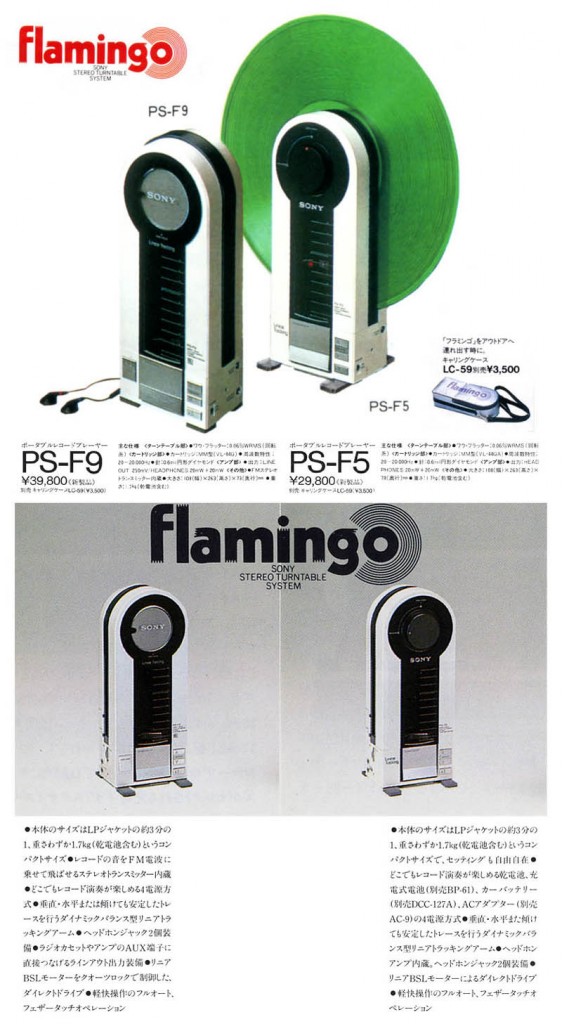
Cost in Today’s Money
I don’t know what these devices sold for in Europe or The U.S., but in the above image you can see that the F9 sold in Japan for Â¥39,800 and the F5 for Â¥29,800. That roughly converts to the F9 being £107 (US$163) in 1983 and the F5 £80 (US$122). In today’s money, that’s around £260 ($350) for the F9 and £200 (US$260) for the F5. So these devices weren’t cheap.
The fitted soft case works out to around £9 (US$15) in ’83, £25 (US$35) in today’s money.
Things tend to be more expensive in Japan than the West (especially the U.S.), but this gives us an idea.
Two owners have written in to say that they paid US$39.95 and US$49.90, although this was a while after the product’s launch and these were likely to be knocked-down prices.
Linear Tracking
If the arm is not pivoted, but instead travels horizontally along a radius of the disc, there is no skating force and no cartridge angle error. Such arms are driven along a linear track using an electronic servomechanism, or a precise mechanical adjustment to position it properly.
Early Edison phonographs had used similarly horizontal spring-powered drives to carry the stylus across the record at a pre-determined rate. In practice, the linear tracking system is not widely used today because of its complexity and related expense. However, some of the most sophisticated and expensive systems still employ this technique. It is nearly ideal, as the stylus replicates the motion of the recording lathe when the master recording was cut. (Source: Wikipedia)
Direct Drive
A direct-drive turntable is one of two main phonograph designs being manufactured today. The other style is the belt-drive turntable. Each name is based upon the type of drive motor used. Both are primarily for playing 12″ and 7″ vinyl disc records.
In a direct drive turntable the motor is located directly under the center of the platter and is connected to the platter directly. The first commercially available direct-drive turntable, the model SP-10, was introduced by the Technics division of Matsushita in 1969.
Direct drive turntables may suffer from vibration due to the motor. This is less of an issue for belt-drive turntables. However, in recent years, shock-absorbing (less dense) material, placed between the motor and platter, has been used to cut back on vibrations. The torque on direct drive turntables is usually much higher than on belt drive models. This means the platter speed is less susceptible to outside forces (stylus, hand). Higher torque also means the platter will accelerate to its proper speed faster so less distortion is heard when the record begins to play. (Source: Wikipedia)
